The Foundation of Autonomous Cruising
In the realm of modern marine technology, solar power is no longer merely a method for trickle-charging a starter battery; it is the primary lifeblood of the vessel. Achieving energy independence on the water heavily relies on maximizing the surface area available to photovoltaic (PV) cells while ensuring these delicate components can withstand the aggressive combination of saltwater, high winds, ultraviolet degradation, and mechanical stress.
When engineering a solar-powered yacht, architects look beyond bolting rigid panels to an arch. The objective is holistic integration. The decking, the bimini, the coach roof, and sometimes even the hull sides are evaluated for their solar yield potential. This has led to rapid advancements in the form factor and efficiency of marine-specific solar technologies.
Types of Marine Solar Panels
1. Rigid Monocrystalline Panels
Rigid panels remain the gold standard for pure efficiency and longevity. Constructed using single-crystal silicon enclosed in tempered glass and framed in anodized aluminum, these panels offer the highest conversion rates—often exceeding 22% in optimal conditions. Their robust build provides excellent heat dissipation, which is crucial because solar cell efficiency drops as temperatures rise.
Pros: Highest power output per square meter, exceptional durability, superior heat management, lowest cost per watt.
Cons: Heavy, non-aerodynamic profile, requires flat surfaces or dedicated mounting arches, susceptible to micro-cracking if walked upon.
2. Flexible (Semi-Flexible) Thin-Film & Monocrystalline
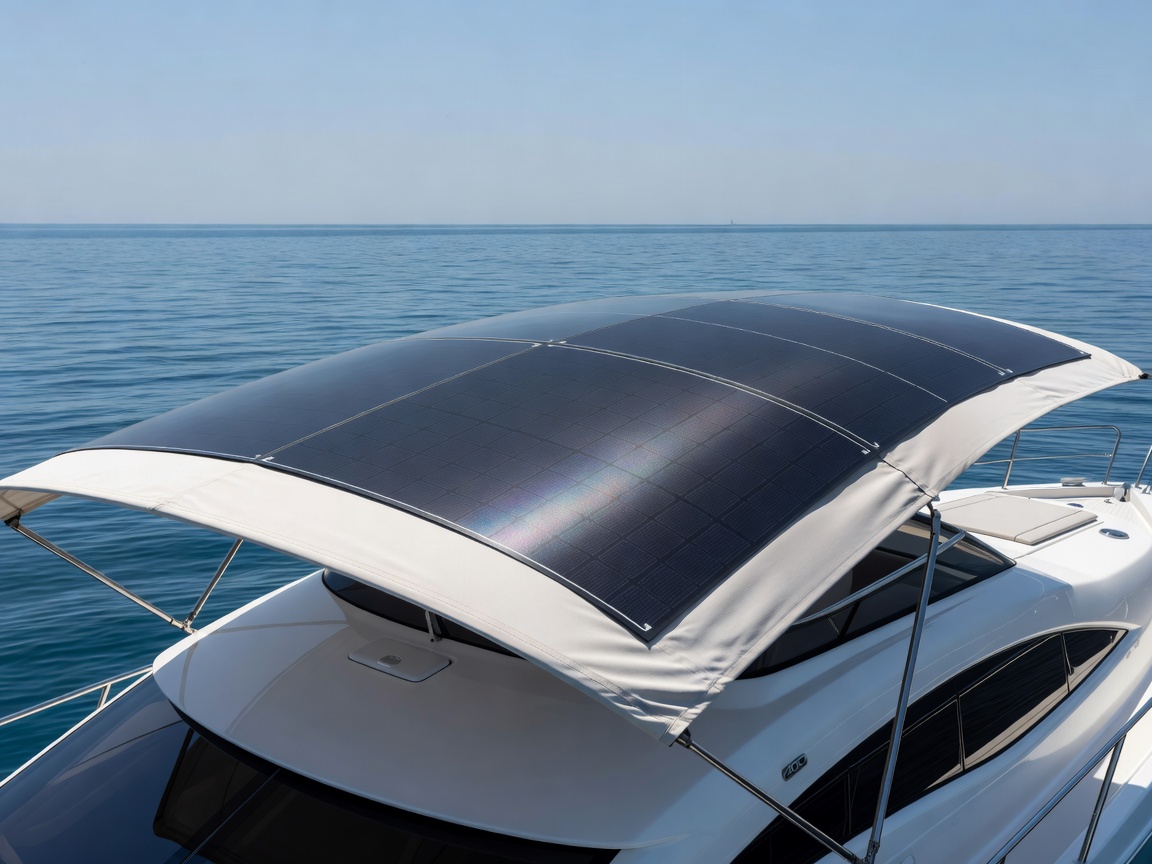
Flexible panels have revolutionized marine solar. Using advanced polymers like ETFE (Ethylene Tetrafluoroethylene) instead of glass, these panels can bend up to 30 degrees, allowing them to follow the natural camber of a boat’s deck or bimini. Modern flexible panels often use high-efficiency monocrystalline cells, bridging the gap between adaptability and power.
Pros: Extremely lightweight, aerodynamic, can be walked on (with appropriate backing), aesthetically pleasing integration.
Cons: Poor heat dissipation leading to lower efficiency in hot climates, generally shorter lifespan than rigid panels due to thermal cycling and physical flexing.
3. Walk-on Composite Panels
A hybrid approach involves embedding monocrystalline cells into high-density structural composites. These are designed specifically to be integrated flush into the deck of a yacht. They feature non-slip surfaces and are engineered to endure the point-loading of crew members' footsteps without damaging the underlying silicon cells.
Shading and Bypass Diodes
A yacht is an environment fraught with moving shadows. The mast, rigging, boom, and radar domes constantly cast hard shadows across the deck as the vessel swings at anchor or changes tack. In standard solar panel architecture, a small shadow on a single cell can dramatically reduce the output of the entire panel, or even the entire array.
To combat this, marine solar arrays rely heavily on bypass diodes. These small components act as electrical detours. If a section of the panel is shaded and stops producing power, the diode allows the current from the unshaded sections to bypass the inactive cells. Designing a system with multiple, smaller panels wired with individual MPPT (Maximum Power Point Tracking) controllers yields significantly better daily watt-hour production than relying on a single massive array routed through one controller.
Yield Expectations and Sizing
Calculating the required solar array for a yacht involves creating a comprehensive energy budget. An electric propulsion yacht living exclusively on solar will require significantly more wattage than a hybrid sailing vessel. Generally, designers aim to harvest enough energy during five hours of peak sunlight to cover 24 hours of "house" loads (refrigeration, navigation, lighting, watermaking), while leaving surplus energy to trickle into the propulsion bank.
A well-optimized 40-foot solar catamaran might carry between 2,000W and 4,000W of solar capacity. In tropical conditions, a 3,000W array might yield between 12kWh and 15kWh per day, enough to replenish daily living draws and provide enough propulsion reserve for modest, slow-speed maneuvering.